Case Study Details

Rejected in 2024 → Accepted in 2025

De Gruyter

Entrepreneurship Research Journal (De Gruyter) | Management (SSCI-Q4 Category)

Case Snapshot

    Project Identification

  • Order ID: KKK_18_Publication#Management_SSCI-Q4
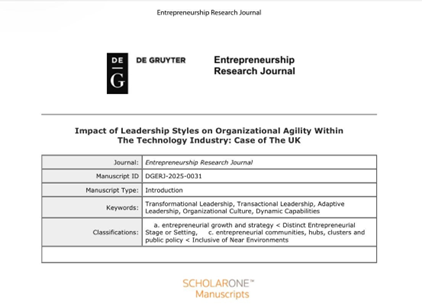
  • Target Journal: Entrepreneurship Research Journal (De Gruyter) Submission System: ScholarOne Manuscripts
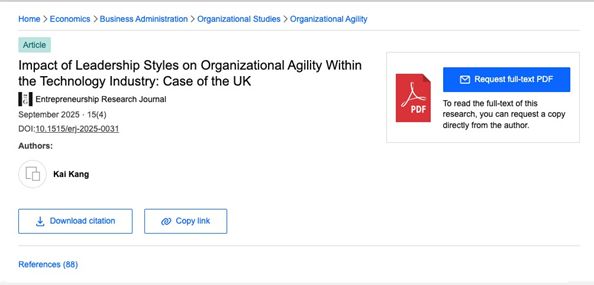
  • Manuscript Title: Impact of Leadership Styles on Organizational Agility Within the Technology Industry: Case of the UK
  • Keywords / Model Focus: Transformational, Transactional, Adaptive Leadership → Organizational Culture & Dynamic Capabilities → Organizational Agility (SEM)

Starting Point


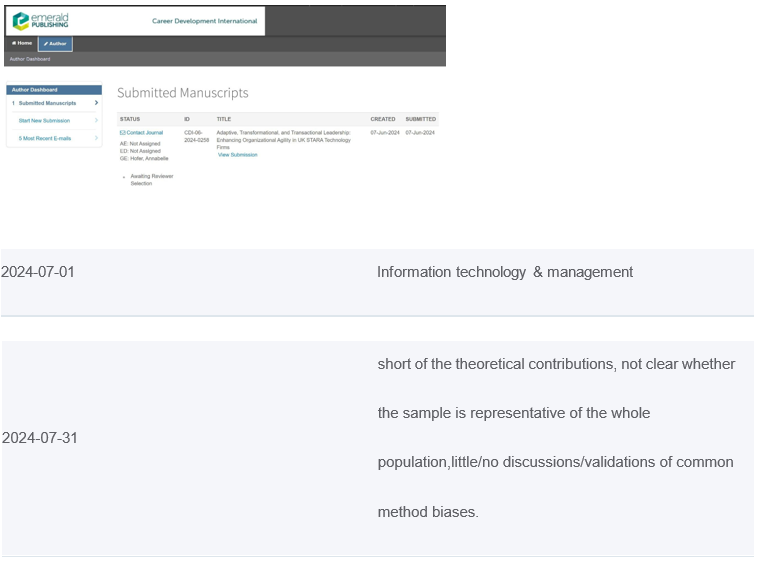
  • The client approached us after the manuscript had already faced multiple rejections in 2024

  • At the time of takeover, the manuscript had strong core direction, but reviewers consistently highlighted concerns around:

  • • Flow, readability, and clarity
  • • Weak positioning and contribution clarity
  • • Insufficient “authors’ own arguments” supporting hypotheses
  • • Justification gaps (why these leadership styles; why UK STARA context)
  • • Justification gaps (why these leadership styles; why UK STARA context)
  • • Reference integrity issues (missing references; mismatch between in-text citations and reference list)
  • • Practical implications needing strengthening (avoid repeating findings, add real implications)

  • Goal: Convert a rejection history into a structured, compliant submission that could move through peer review and reach acceptance.

  • Evidence to attach here:
  • • Rejection/previous submission history screenshots (2024)
  • • Early reviewer feedback screenshots showing clarity and contribution issues

Journal Targeting & Strategy


  • We aligned the manuscript with Entrepreneurship Research Journal based on:

  • • Fit with organizational agility, leadership, and technology industry context
  • • Suitability for a structured SEM-based management study
  • • Editorial style and publication scope match

  • We chose an approach optimized for success in peer review:
  • 1. Fix core positioning + contribution first
  • 2. Strengthen theoretical logic behind each hypothesis
  • 3. Improve language clarity to meet reviewer expectations
  • 4. Tighten method detail and contextual justification
  • 5. Clean references to remove production-stage risk

Submission Execution


  • Manuscript submitted by our team: 15 April 2025
  • Submission was executed through ScholarOne, including correct package structuring and journal-required files.

Peer Review Outcome: Major Revision


  • Decision received: Major Revision: 19 May 2025
  • Revision deadline given: 30 May 2025
  • Journal instruction: Revised manuscript must include:
  • • Point-by-point response to reviewers
  • • Revised files uploaded under Author’s Response to Reviewer/Editor Critique

What the Reviewer Requested (Key Points)


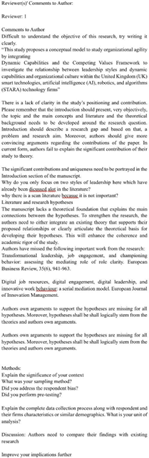
  • Reviewer 1 emphasized the manuscript needed stronger scholarly quality in multiple areas:
  • A) Language + Clarity (Top priority)
  • • “Flow, readability, and clarity is lacking… expert help shall be sought…”
  • B) Positioning & Leadership Styles Justification
  • • Stronger justification for choosing transformational, transactional, adaptive leadership styles
  • • Expand introduction support with literature
  • C) Stronger Hypothesis Logic
  • • Add at least three authors’ own arguments for each hypothesis
  • • Ensure hypotheses logically stem from theory and authors’ arguments
  • D) Context Justification: UK STARA Setting
  • • Strengthen justification for UK STARA (Smart Tech, AI, Robotics, Algorithms) setting as an appropriate population
  • E) Discussion & Implications
  • • Add specific references in discussion
  • • Improve theoretical contribution (avoid being “only literature review”)
  • • Remove “findings” from managerial implications; add real implications

Our Revision Work: Step-by-Step Actions Taken


  • Step 1: Rewrite for Flow, Readability, and Academic Clarity
  • We improved the manuscript’s readability with:
  • • clearer sentence structure
  • • removal of unnecessary future tense in introduction
  • • improved transitions between sections
  • • consistent terminology across constructs

  • Outcome: The manuscript read like a journal paper, not a report.

  • Step 2: Strengthen Positioning & Contribution (Introduction Upgrade)
  • We reworked the introduction to ensure it:
  • • states the research problem clearly
  • • defines the research gap
  • • positions the contribution (theoretical + practical)
  • • frames why the model is relevant in the technology/STARA context

  • Step 3: Add “Authors’ Own Arguments” for Each Hypothesis
  • For each hypothesis, we added:
  • • explicit theoretical grounding
  • • at least three clear arguments linking constructs
  • • stronger logic chain (theory → mechanism → expected relationship)

  • This directly addressed the reviewer request.

  • Step 4: Expand Justification for Leadership Styles in Literature
  • We improved justification for choosing the leadership styles by:
  • • adding targeted literature support
  • • linking each style to agility requirements
  • • clarifying why these are relevant to STARA environments

  • Step 5: Improve Context Justification (UK STARA Setting)
  • We expanded and strengthened the justification for:
  • • why STARA firms face unique agility requirements
  • • why leadership and capability-building matter more in STARA contexts
  • • why this is a valuable empirical setting for the model

  • Step 6: Discussion Upgrade + Real Implications
  • We improved:
  • • comparison with existing studies
  • • theory implications (what this adds)
  • • managerial implications (actionable and practical; not a repeat of results)
  • • inserted journal-quality references into discussion where needed

  • Step 7: Revision Package Preparation (Mandatory for ScholarOne)
  • We prepared the required revision package:
  • • revised manuscript file
  • • structured point-by-point response document
  • • ensured correct upload designation in ScholarOne:
  • Author’s Response to Reviewer/Editor Critique


Second Round & Acceptance


  • After revisions and response submission, the paper progressed through review.
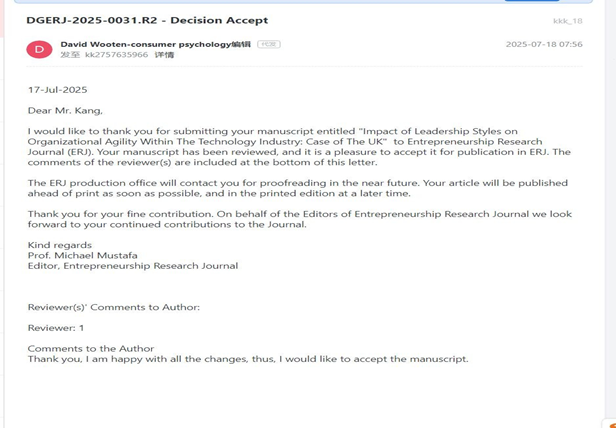
  • Final decision: Decision Accept — 17 July 2025

  • The acceptance email confirms:
  • • acceptance for publication in Entrepreneurship Research Journal
  • • production team will contact for proofreading

  • • publication ahead of print and later print issue

Post-Acceptance Production Corrections (We Handled These Too)


  • After acceptance, the manuscript entered production checks. We supported the author through additional editorial compliance requirements, including:
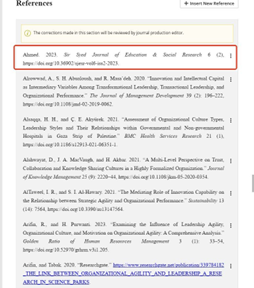
  • 1. References “Bass & Avolio, 1994; Eisenbeiß & Boerner, 2013; Burns, 1978; Judge & Piccolo, 2004; Heifetz et al., 2009; Uhl-Bien & Arena, 2018; Hoonsopon & Puriwat, 2019; Li et al., 2020; Khairy & Shah, 2023; Podsakoff et al., 2003” are cited in the text but not provided in the reference list. Please provide them in the reference list or alternatively delete the citations from the text.
  • 2. The citation ‘Jobst et al., 2021 and Wang & Rhemtulla, 2020’ has been changed to ‘Jobst et al., 2023 and Wang and Rhemtulla, 2021’ to match the author name/year in the reference list. Please check here and in subsequent occurrences, and correct if necessary.


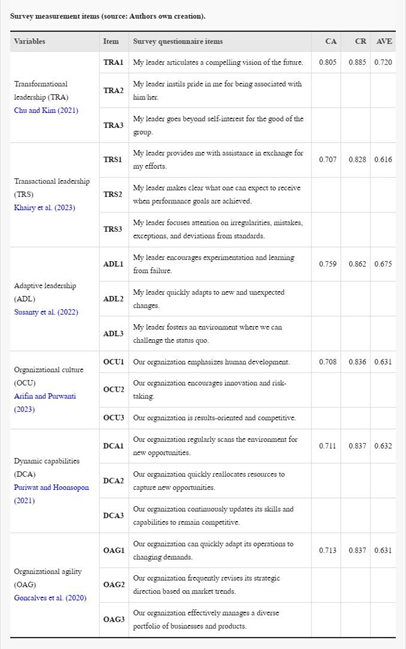
  • 3. Provide the meaning of the bold values provided in Table 3.


  • 4. Please note that as per style, if there are more than 6 authors/editors, the first 6 author names are listed followed by ‘et al’ if the author group consists of 6 authors or fewer, all author names should be listed. Therefore, in References. ahmed, 2023; teece, 1997; please list all names for up to 6 authors/editors. For more than 6 authors/editors, use ‘et al’ after the first 6 authors/editors.


  • 5. References “Ahmed, 2023; Arifin and Tabak, 2020; De Miguel et al., 2022; Haase and Franco, 2020; Holtom et al., 2022; Khalil and Belitski, 2020; Kim and Lee, 2021; Sabahi and Parast, 2019; Schriber and Löwstedt, 2020; Tomaselli et al., 2021; Xiong et al., 2023; Yu et al., 2023; Zia et al., 2024” that occur in the list but not cited in the body of the text are placed in this section. Please cite each reference in the text or, alternatively, delete it.
  • 6. Please provide the issue number for the references “Blichfeldt and Faullant, 2021; Dabić et al., 2021; Darvishmotevali et al., 2020; Ferreira et al., 2020; Hartnell and Walumbwa, 2011; Idrees et al., 2022; Isensee et al., 2020; Li et al., 2021; Liang et al., 2022; Lingmont and Alexiou, 2020; Nadkar et al., 2023; Sarwar et al., 2022; Tong, 2020; Trenerry et al., 2021; Wang et al., 2022; Wang and Qing, 2023; Xiong et al., 2023”.
  • 7. Please provide the volume number and page range for the references “Hutter et al., 2023; Yildiz and Aykanat, 2021; Yu et al., 2023; Zeid et al., 2023; Zia et al., 2024”.
  • 8. Please supply the name of the city for the references “Sarstedt et al., 2017”.
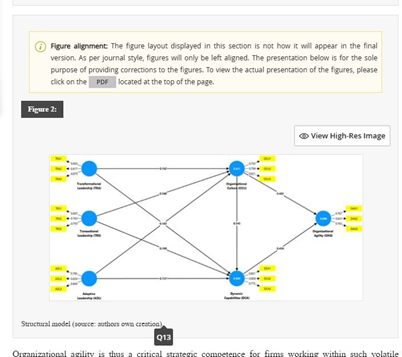
  • 9. For Figure(s) 2, Please note that the figures have been sized to their maximum width; however, the text size within the figures remains below 6 points. To proceed further, kindly submit the revised figures ensuring that the text size adheres to the requirement of 6 points.


  • 10) Outcome Summary
  • • Paper previously rejected across multiple journals during 2024
  • • Manuscript submitted by our team: 15 April 2025
  • • Major revision received: 19 May 2025
  • • Revision package prepared and submitted with point-by-point response

  • • Final acceptance: 17 July 2025
  • Post-acceptance production compliance handled (references, citation consistency, figure quality, table clarifications)


  • Result:Re Successful acceptance in Entrepreneurship Research Journal after a structured revision strategy and compliance-led execution.